Dispatch No. 7: Headlands and Glass
Mendocino, California
I love the coast. Not in a vague, postcard way people say it. I mean in the specific chemistry of it. The smell of sea air working on you before you've even seen the water, the way the light changes the rock's color hour to hour, the sensory experience that only exists right at what feels like the edge of the world. You just can't get that anywhere else. You can't bottle it. You just have to keep coming back. We were back on the coast, and that was enough for me.
The Day Starts Slow
We started with an early lunch at Flow, out on the patio where the open air looks straight out over the headlands and down toward the Ford House. That old museum that anchors this stretch of the coastline with its white clapboard and history, keeping an eye on the water for longer than anyone currently walking past it.
The view was the first thing I noticed. The headlands and the Ford House sitting below the patio like the coast was putting on a show just for the early lunch crowd. But it was the table next to us that actually caught my attention: two women deep in a debate over Dead & Co at the Sphere versus the real thing, days spent following the Grateful Dead around before either of us was born. I caught Bryan looking at me out of the corner of my eye. He knows exactly what kind of Deadhead he's with, and he knew this one was going to pull me in. I had to weigh in.
“ I'll take the Grateful Dead over Dead & Co. any day!”
Somewhere in the conversation that followed, it came out that they were both retired nurses. Of course they were. I was the only one of the three of us still at the bedside.
Bryan, never one to miss an opening, mentioned the blog, what it was, why I write it, and that was the thread that pulled the whole conversation somewhere heavier. We talked about nursing then and now. What it was like working through COVID, back when the job asked of us things that nothing had prepared us for and that nothing since has fully accounted for. We talked about burnout, and how it's stopped being an individual problem people quietly carry and started looking like its own kind of epidemic; moving through the profession the way any pandemic moves, person to person, unit to unit, nobody quite immune. Two nurses who'd already gotten out, and me, still in it, comparing notes on a patio over lunch like it was the most normal thing in the world. It was, and that was the strange part. #NurseLife, lol.
We also talked music, hiking trails they'd loved, and the string of adventures Bryan and I had already racked up on this trip. Somewhere in there, we also made the loose kind of plan you make on a trip like this: walk the headlands now, save Point Cabrillo Lighthouse for later in the day, when the light would be doing something different.
The Trail
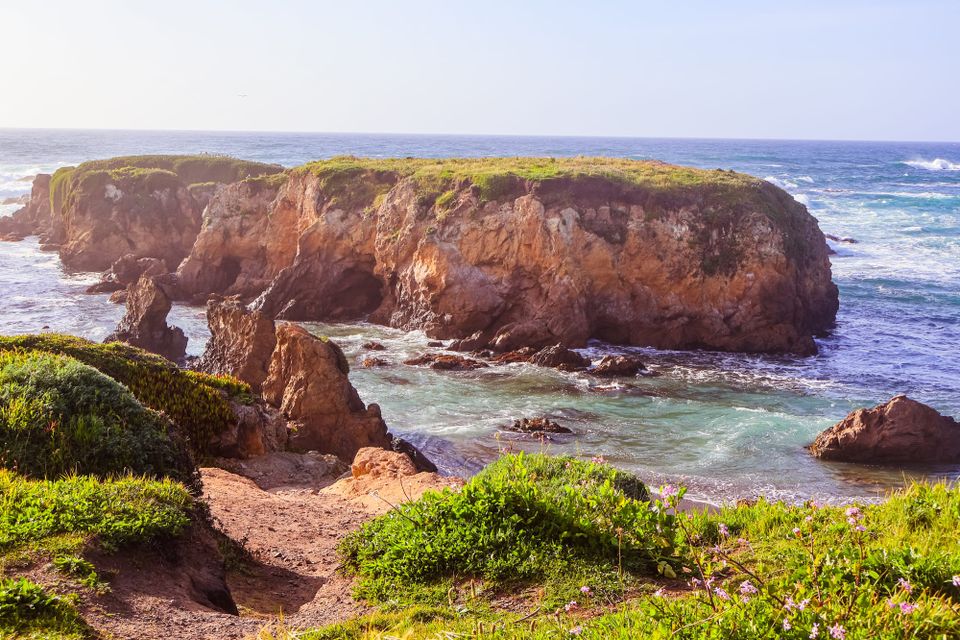
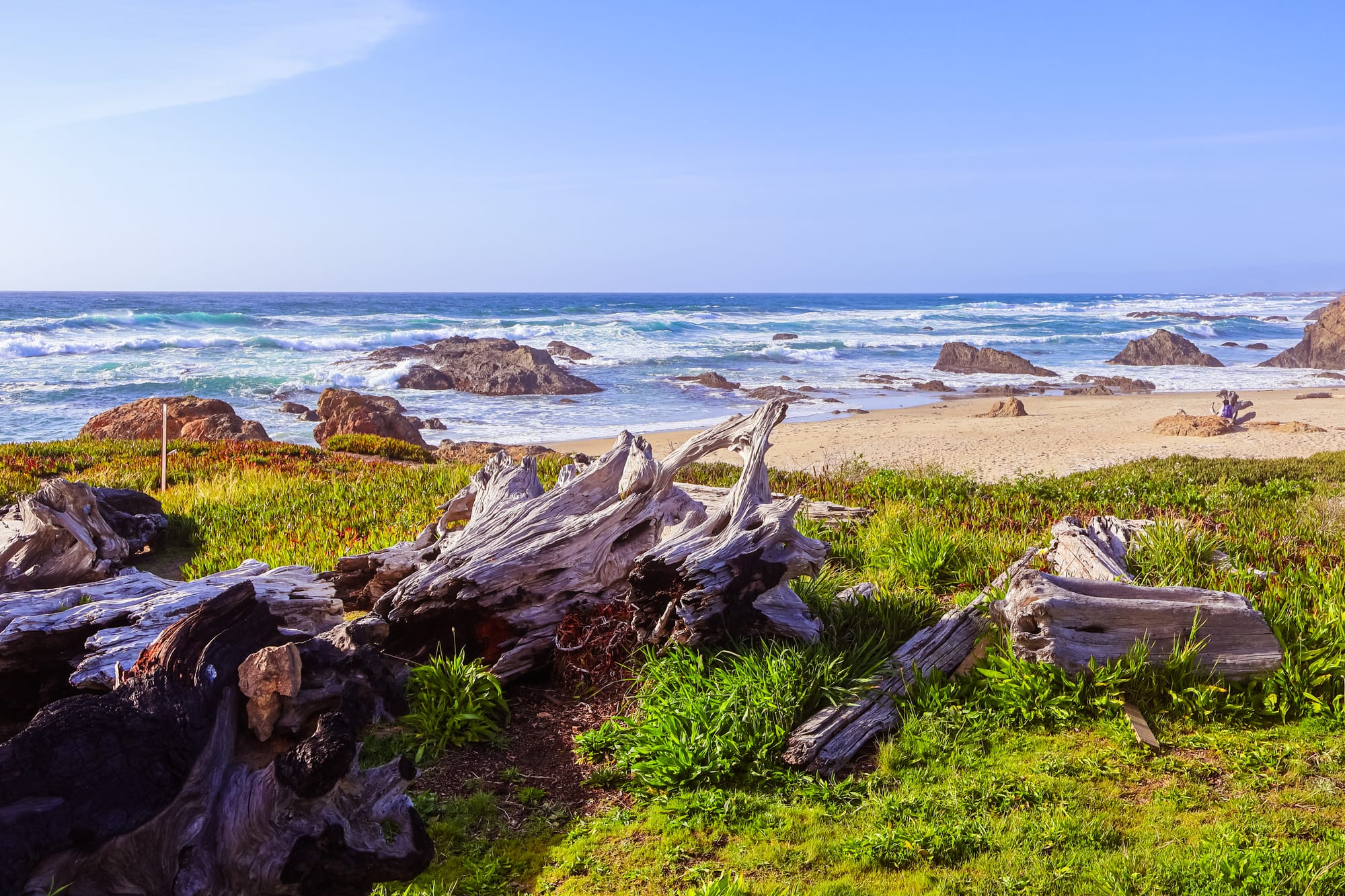
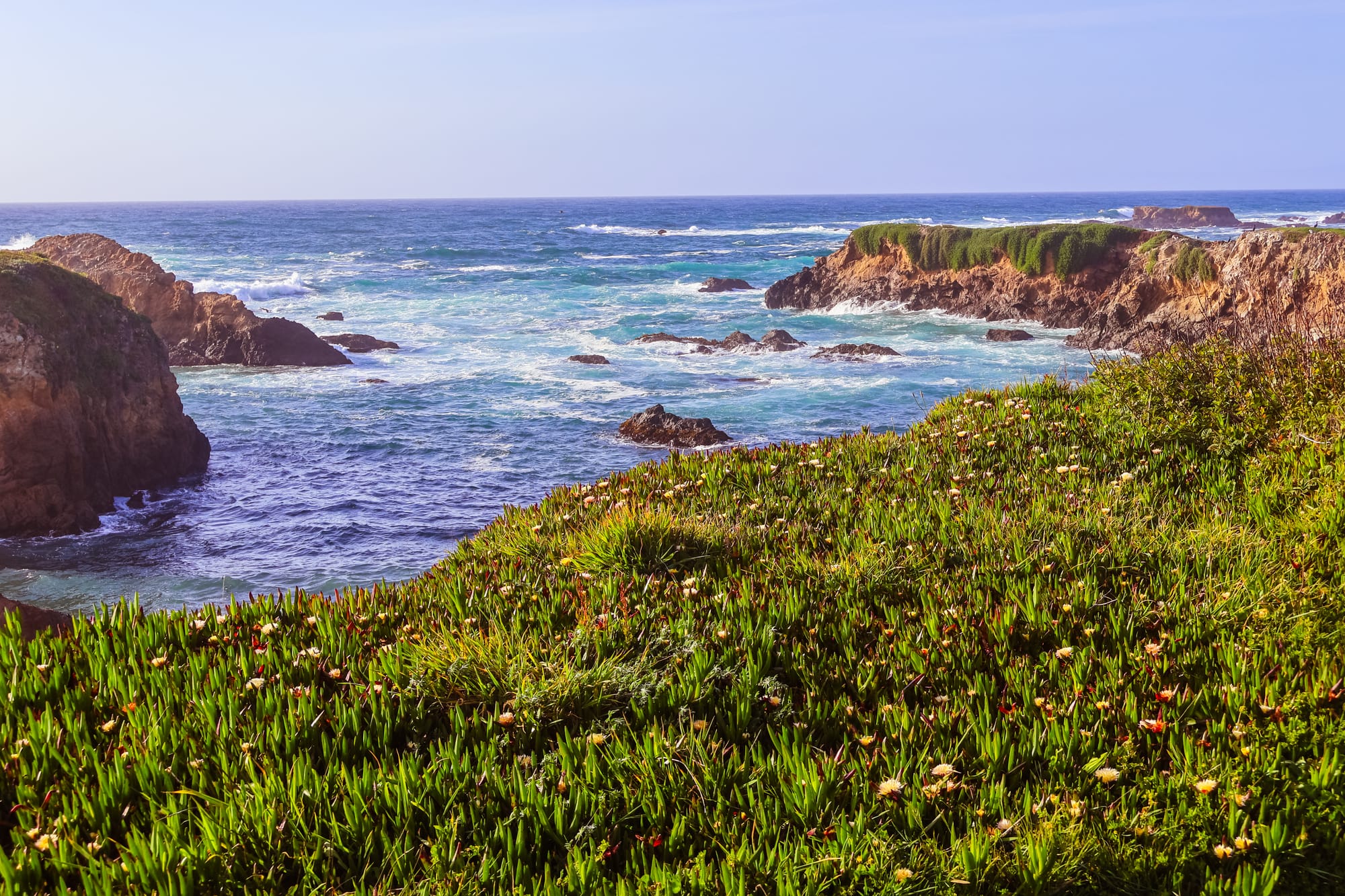
The Mendocino Headlands do not so much begin as reveal themselves. One turns on a grassy path, and suddenly there's a sea stack standing alone in the surf, arched clean through by centuries of water finding the softest stone first. The trail runs along cliffs of layered gold and rust, past coves where the Pacific comes in turquoise and leaves white.
This is a coastline that doesn't ease you in. It just opens up to the edge of the world.
Tide pools sat rust-colored with seaweed in the low spots between rocks. Wildflowers leaned into the wind along the cliff edge. Yellow and white and impossibly small against all that stone. Somewhere past a stretch of wind-bent grass, a wire fence and a wooden gate marked the edge of the trail, the town of Mendocino sitting quietly in the distance across the meadow like it was minding its own business.
We stopped where the rock walls framed a narrow beach and just breathed in the cold-salt smell, the particular gray-gold light, the sound of the water working the rock the way it's always done for ten thousand years.
Point Cabrillo
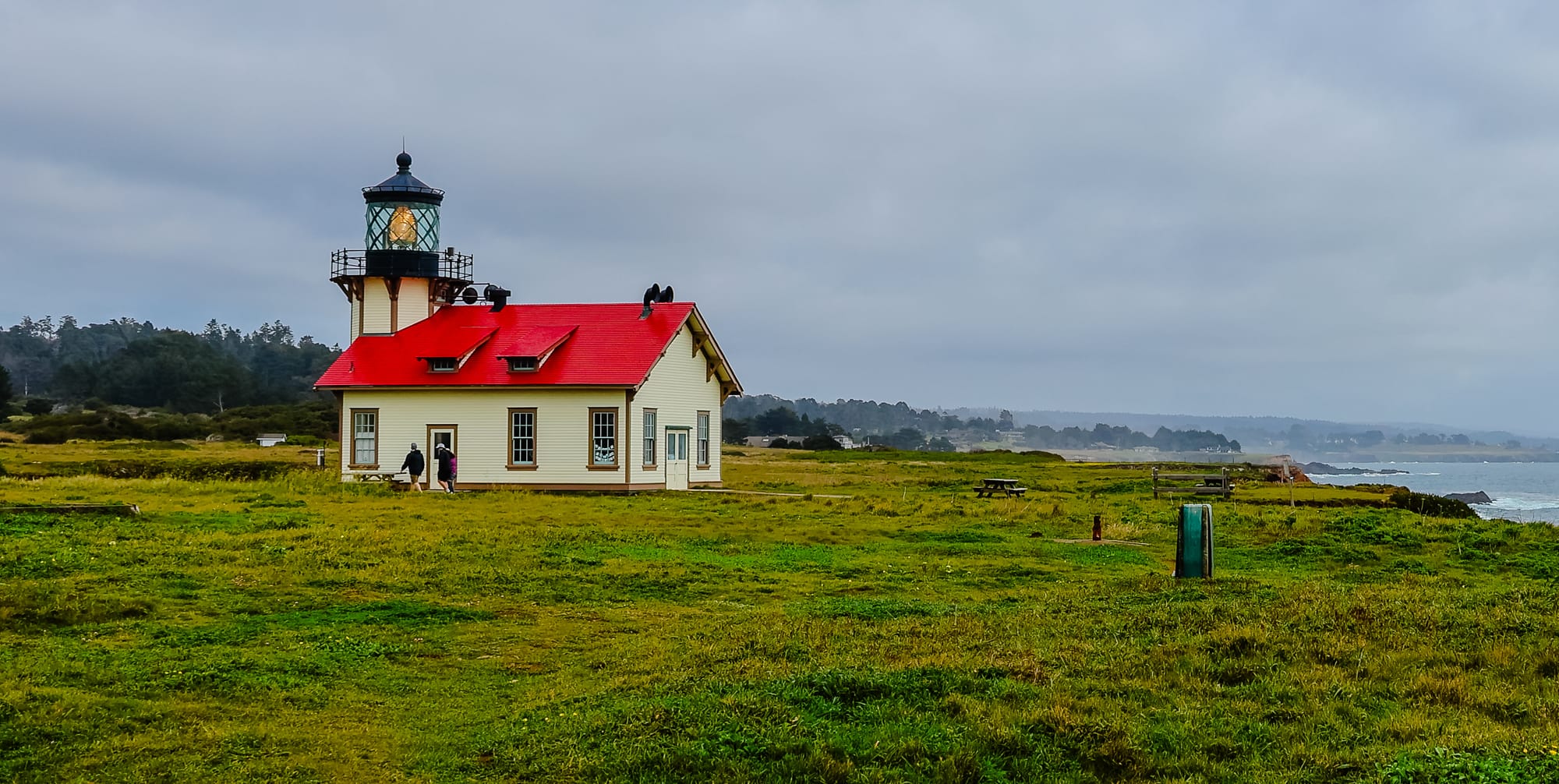
By the time we reached Point Cabrillo, the sky had turned more gray, the kind of flat coastal overcast that makes everything look a little more solemn than it did at lunch. The lighthouse has been standing on that headland since 1909. Inside the lantern room sits a third-order Fresnel lens, shipped over from England by a company called Chance Brothers, one of only a handful of its kind still operating anywhere in the country. The lens throws its beam out thirteen to fifteen miles, rotating once every forty seconds so the light reaches a ship, disappears, and comes back. A flash every ten seconds, the same rhythm it's kept since a light-keeper first lit it at midnight for an audience of curious neighbors.
There's something about standing under a gray sky next to a light built specifically to cut through darkened skies. It's not for the days like the one we had on the headlands trail, all blue water and easy sun. It's for the nights when a sailor can't see the shore, when the fog rolls in, and the rocks that make this coastline so beautiful become the exact thing that could end you.
Flash, dark, flash, dark. Just as steady as a heartbeat, the same rhythm. A heartbeat doesn't ask where you've been or how far off course you've drifted. It just keeps beating, patient and certain, until you find your way back toward it. That's what that light has been doing out there in the dark this whole time. It’s not just guiding ships home to shore, but showing anyone who feels lost enough to need it that this is the way back to themselves.
Glass Beach, at Evening
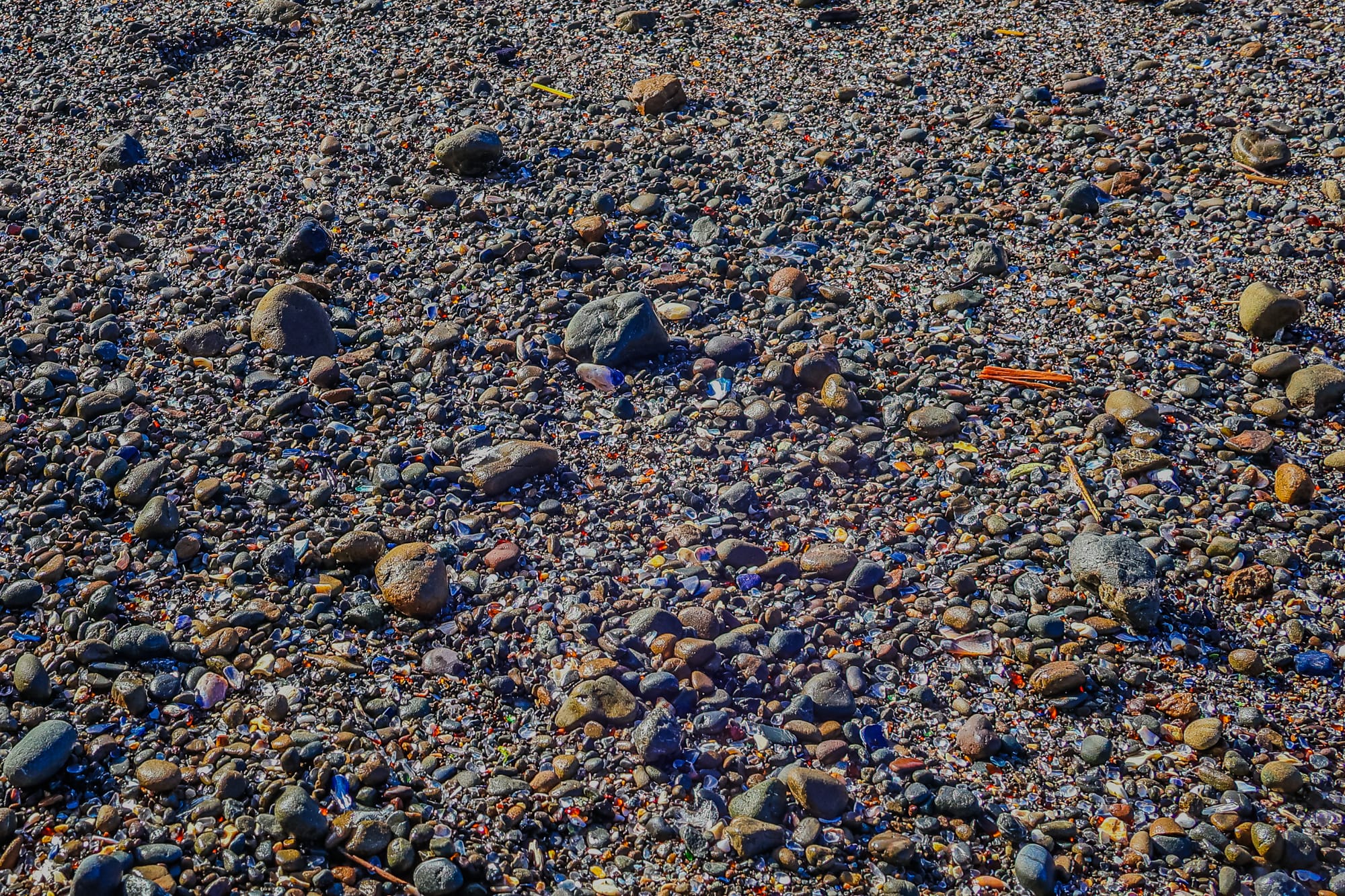
By the time we made it to Glass Beach, the light had gone low and gold, throwing long shadows across a shoreline unlike anything else on this trip. A beach made not of sand but of smoothed sea glass and pebbles, catching the last sun in flashes of amber and green and the occasional flare of red.
A place that used to be a dump is now one of the most photographed beaches on the coast. Decades of glass, tumbled soft by the surf, turned into something people drive hours to see.
The rock walls on either side went dark against the glare off the water, and every step crunched underfoot in a way no other beach does. We didn't say much. Some places don't need narration. They require you to be quiet and let the light do what it's doing as you search for treasure.
I kept thinking about what this beach actually is. Discarded glass. The junk, trash, and stuff nobody wanted anymore sitting under the pull of the tide long enough that the ocean sanded every sharp edge off it and handed it back as something people now drive hours to see. Nothing about what it used to be changed. It's still glass. The ocean just kept working on it, patiently, without asking permission, until what was broken became something you'd want to hold in your hand.
I've been thinking a lot about my own rough edges lately. Burnout that's taken years to admit to, finishing my bachelor's after all this time, standing at the edge of what comes next in my career without a clear answer. None of that feels smooth yet. But maybe it doesn't have to happen all at once. Maybe you just let the right conditions keep working on you, long enough, and one day what felt discarded starts catching the light instead.
What the Coast Gives You
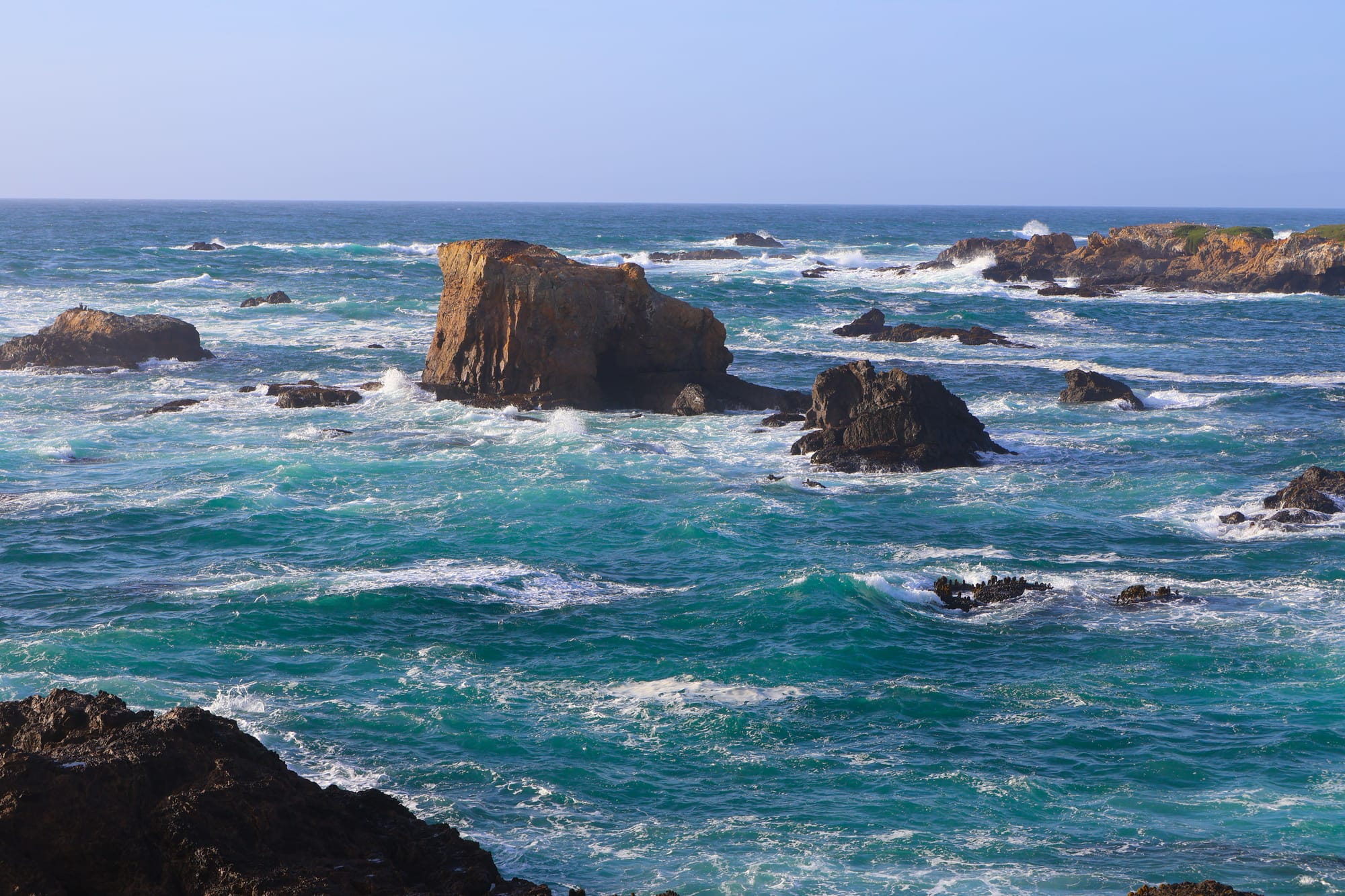
I've thought a lot about why this stretch of coastline does what it does to me, and I don't think it's just one thing. It's the smell of sea air. It's the color the rock takes on depending on where the sun is. It's standing somewhere loud, unable to hear anything but water and wind. Just the coast, doing what it does, whether or not anyone's there to witness it.
Turns out there's a whole field of research trying to explain what I already felt standing on that trail. Environmental psychologists call it "blue space.” Any setting where water is the dominant feature. A growing stack of studies has found that time spent near it is linked to lower stress, better mood, and slower breathing. Some of the proposed reasons are what you'd expect: negative ions kicked up by moving water, the wide-open horizon giving your eyes somewhere restful to land, the sound of waves doing something to the nervous system that white noise machines attempt to artificially reproduce.
One researcher, a marine biologist, Wallace J. Nichols, built a whole career around a concept he calls "blue mind”; the mildly meditative, parasympathetic state that water seems to trigger almost on contact, as opposed to the fight-or-flight "red mind" most of us carry around at baseline. People living near coastlines report better psychological well-being than people who don't, and even brief exposure to open water has been shown to nudge cortisol down and heart rate with it. It can restore your creativity, compassion, and purpose.
None of that surprises a nurse. I've spent years watching what chronic stress does to a body over time, and years watching what happens when you finally let a body rest. The coast doesn't fix anything exactly. But it seems to be one of the few places that can get the nervous system to stand down long enough to remember what stillness feels like. Not fixed. Not solved. Just quiet, for a little while, before the noise finds its way back in.
And still, even here, even doing the thing I love most in the world, the burnout doesn't fully leave. It just goes quiet, running somewhere in the background the way a monitor keeps beeping softly in a room you've left. I can distract myself with beauty. I can hike myself into the kind of tired that feels earned instead of depleted. But it's still there when I stop moving, waiting for me back home, back at the bedside.
Maybe that's the honest version of this story.
It's not that the coast heals you, but that it gives you enough quiet to hear what you actually need to do to continue healing once you get back home.
See you on the trail —
Yours in hiking boots,
Julie · The Nurse Hiker